
AI face scan
GLOWAI / FIELD NOTE
An AI face scan app built on measurement.
Most face apps hand you a number and no explanation. An AI face scan should do the opposite: measure specific things, show you the measurement, and tell you which ones you can actually change. Here's what that looks like in practice.
What an AI face scan actually is
A face scan is a measurement tool, not a verdict. The software locates landmarks on your face — pupil centres, the alar base of the nose, the vermilion border of the lips, the gonial angle of the jaw — and then computes the relationships between them: angles, ratios, and distances.
Those relationships are the part that matters. A single measurement like “eye-to-eye distance: 63.4 mm” means nothing on its own. It becomes useful only when it’s compared against a documented range that facial-anatomy researchers have published.
How the GlowAI scan works
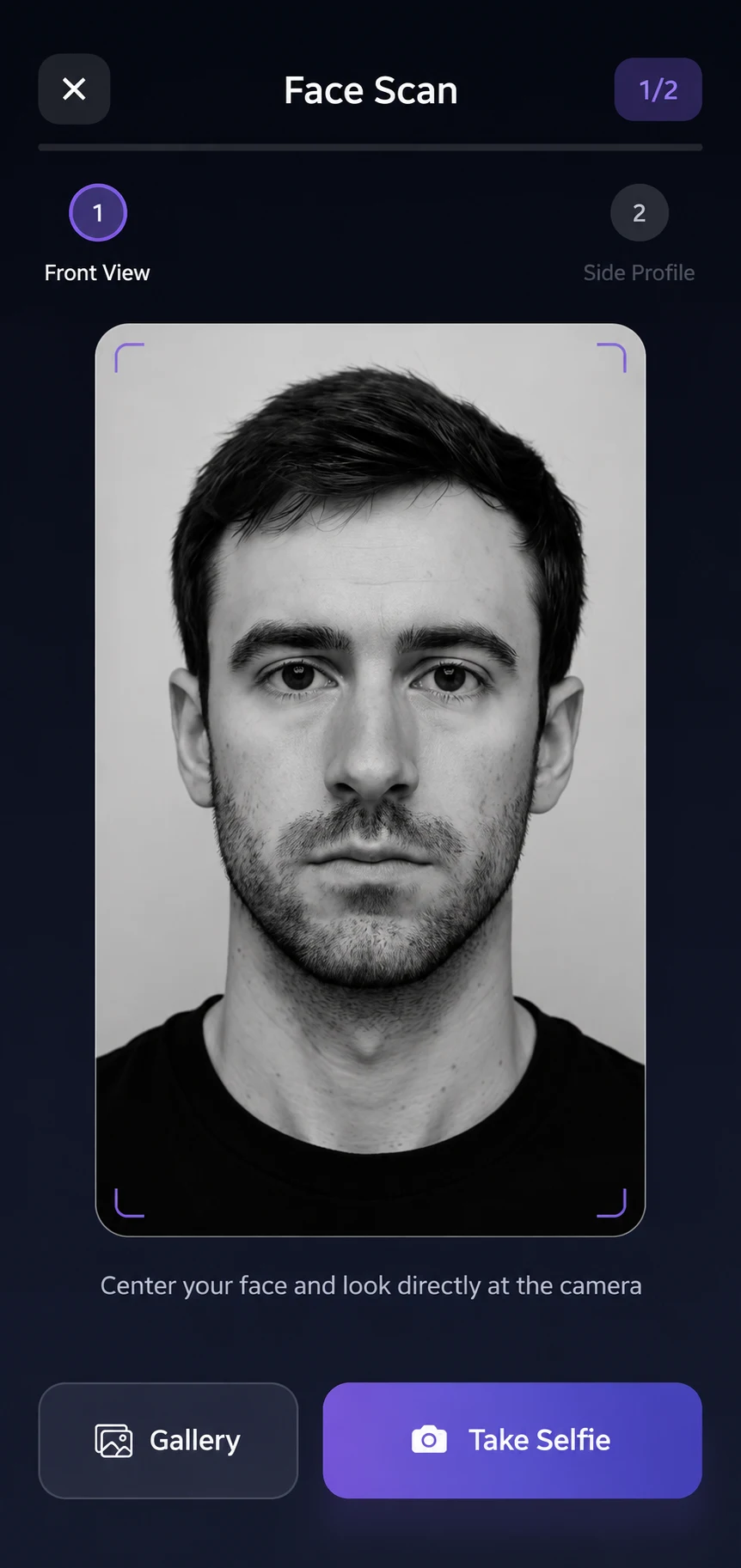
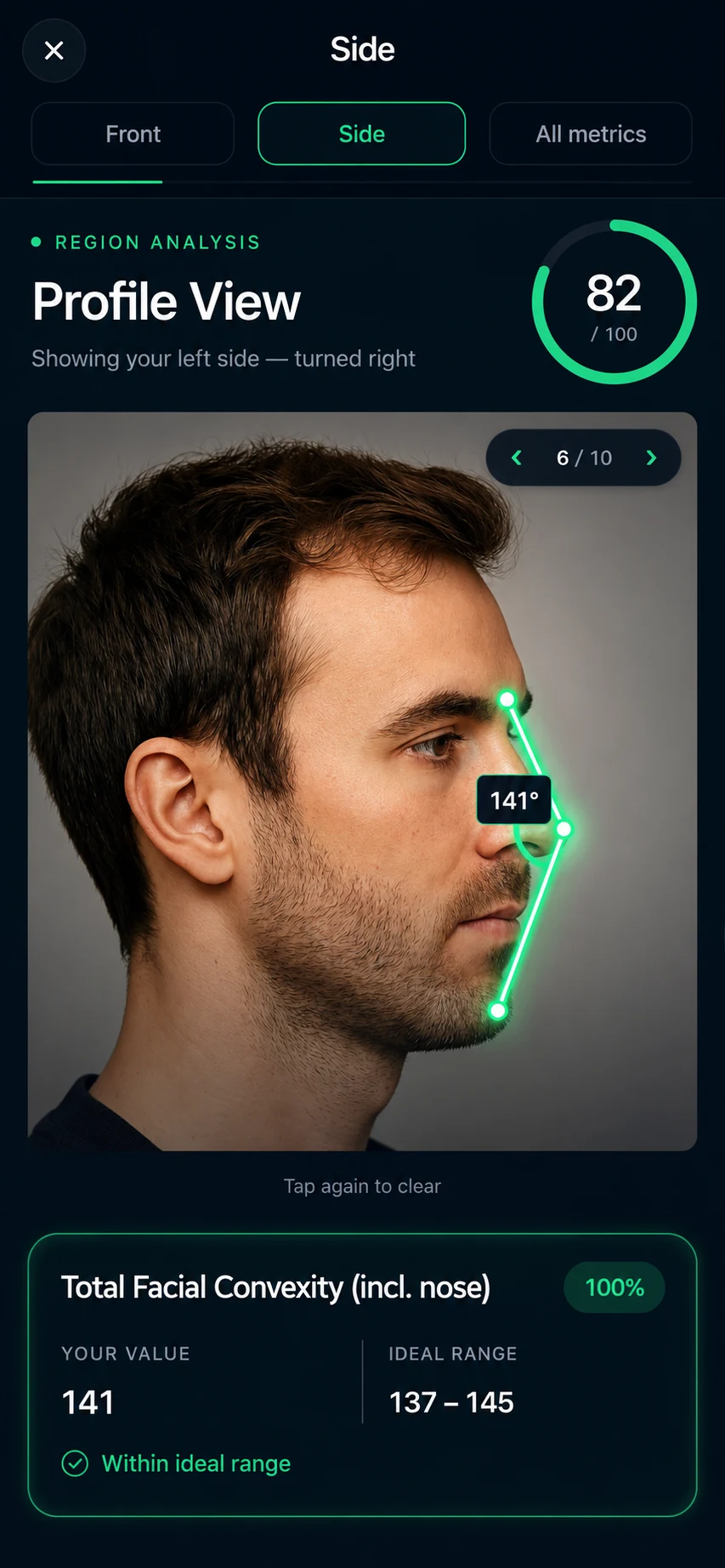
Two photos, taken on a normal phone: one front-facing, one side profile. The front photo carries most of the horizontal geometry — eye spacing, facial fifths, mouth width, jaw width. The side profile carries everything the front photo physically cannot show: chin projection, nasal angles, and total facial convexity.
- Capture. Front view, then side profile. Neutral expression, even light, hair off the jawline.
- Measure. 75 measurements are computed and each is compared against its ideal range.
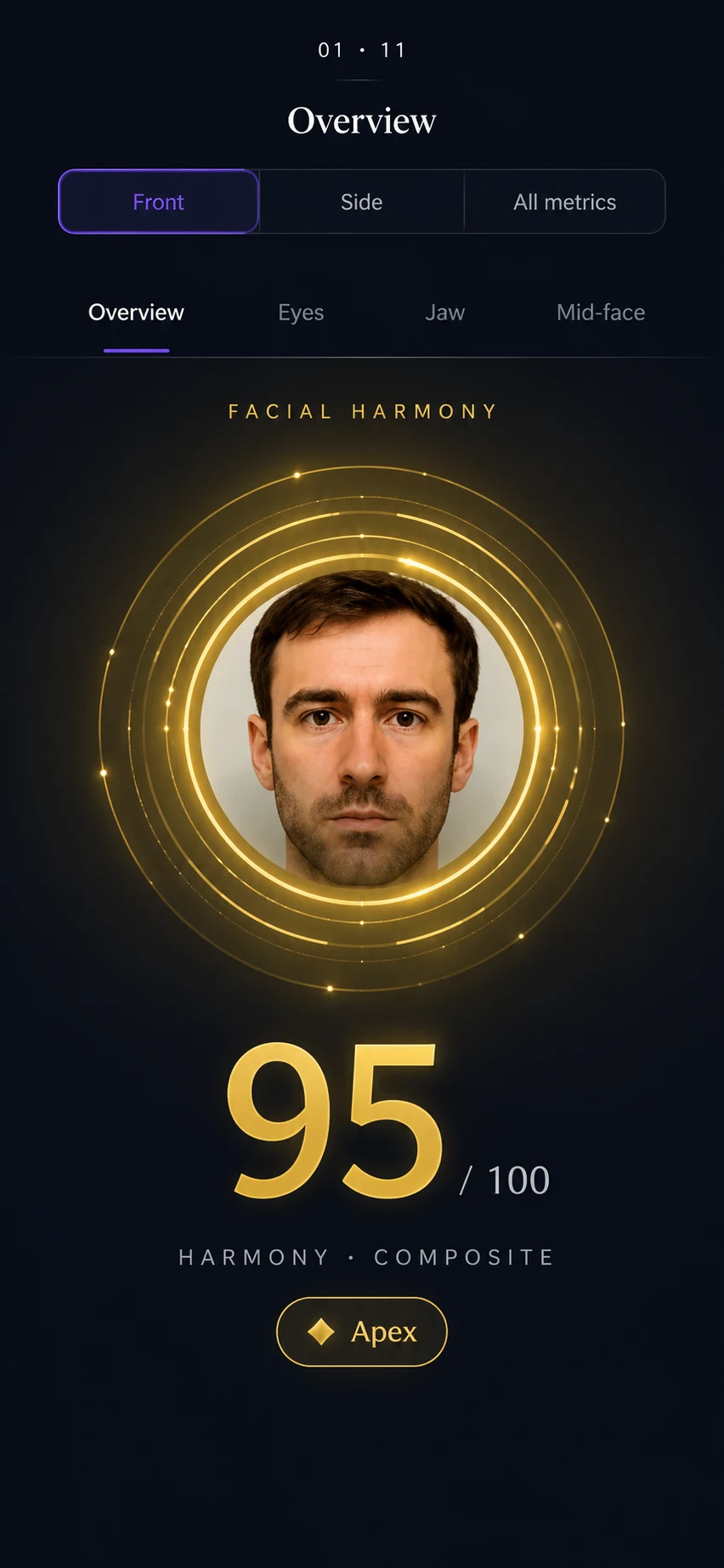
- Score. The individual metrics roll up into one composite harmony score from 0–100.
- Prioritize. Metrics are sorted by how much improving them would move your overall score — and by whether they’re realistically changeable at all.
What gets measured, and against what
Every metric in GlowAI carries the citation it was derived from — published anthropometric work by Farkas, Powell, Naini, Sarver, Goode, and Mommaerts among others. Nothing in the app is a black box you have to take on faith. A representative sample:
| Metric | Example reading | Published ideal range |
|---|---|---|
| Canthal tilt | 6.2° | Ideal 4–8° |
| Facial width-to-height | 1.87 | Ideal 1.65–2.05 |
| Jaw / cheek width ratio | 0.82 | Ideal 0.78–0.86 |
| Gonial angle | 126° | Ideal 120–130° |
| Midface ratio | 1.02 | Ideal 0.95–1.15 |
| Bilateral symmetry | 0.98 | Ideal 0.97–1.00 |
That’s six of seventy-five. The full scan covers the eyes, nose, lips, jaw, chin, midface, and profile.
What a face scan can’t tell you
Being straight about the limits is part of taking measurement seriously:
- It can’t tell you whether you’re attractive. Attraction isn’t a geometry problem, and no anthropometric range captures expression, personality, or presence.
- It can’t give medical or surgical advice. Ideal ranges are population statistics, not treatment plans.
- It can’t out-measure a bad photo. Tilt your head, smile, or shoot in hard side light and the angles shift — that’s a photography problem, not a face problem.
What happens to your photos
Photos are encrypted at rest and stored only inside your own account, until you delete the scan or the account; the signed links used to display them expire within seven days. Deletion cascades to every backend record, not just the copy you can see.
Getting a usable scan
- Face a window, or any large soft light source. Avoid overhead spotlights.
- Neutral expression — no smile, lips together, jaw relaxed.
- Camera at eye level, roughly an arm’s length away.
- Hair off the forehead and jawline; glasses off.
- For the side profile, turn a full 90° rather than three-quarters.
GlowAI runs on iOS 15.5+ and Android 9+, and the scan pipeline is identical on both. You can read more about how the whole app fits together, or how the same measurements get turned into a day-to-day plan.
Common questions
How accurate is an AI face scan?
Accuracy depends on your photos, not the marketing. GlowAI measures geometric relationships — angles, ratios, distances — from a front and side photo, so even lighting, a neutral expression, and a straight-on camera angle matter more than anything else. Measurements are repeatable: scan twice under the same conditions and the numbers land in the same place.
What does an AI face scan actually measure?
GlowAI measures 75 geometric ratios — eye angle and spacing, nose projection, lip-to-nose angle, facial thirds and fifths, jaw and chin geometry, and facial convexity in profile — then compares each against ideal ranges drawn from published anthropometric literature.
Do I need special equipment to scan my face?
No. A normal phone camera is enough. GlowAI needs one front-facing selfie and one side profile, taken in even light with a neutral expression and no glasses or hair covering the jawline.
Is the face scan free?
Your first scan, your harmony score, and a guided look at your top three fixable metrics are free. Scan history, ongoing coach memory, and routine planning are part of the paid tier.
Sources
Ideal ranges are taken from published anthropometric literature. Every metric in the app carries its own citation; these are the works the set is built on.
- Farkas LG. Anthropometry of the Head and Face. 2nd ed. Raven Press, 1994. (opens in a new tab)
The reference dataset for human craniofacial measurement — the source of most normative ranges in use today.
- Powell N, Humphreys B. Proportions of the Aesthetic Face. Thieme-Stratton, 1984. (opens in a new tab)
Defines the profile angles — nasofrontal, nasofacial, nasomental, mentocervical — used in the side-profile analysis.
- Naini FB. Facial Aesthetics: Concepts and Clinical Diagnosis. Wiley-Blackwell, 2011. (opens in a new tab)
Modern synthesis of facial proportion assessment, and the source for several vertical-thirds and horizontal-fifths ranges.
- Sarver DM. Esthetic Orthodontics and Orthognathic Surgery. Mosby, 1998. (opens in a new tab)
Soft-tissue analysis — lip projection, smile arc and incisor display.
- Mommaerts MY, et al. Published work on facial proportion and orthognathic planning. (opens in a new tab)
Contemporary maxillofacial ranges, including midface and chin projection.
- Steiner CC. Cephalometrics for you and for me. Am J Orthod, 1953. (opens in a new tab)
The Steiner analysis — the cephalometric baseline for skeletal relationships.
- Tweed CH. The Frankfort-mandibular incisor angle in diagnosis and treatment planning. (opens in a new tab)
The Tweed triangle, behind the mandibular-plane and incisor-angle metrics.
- Google. MediaPipe Face Mesh / Face Landmarker. (opens in a new tab)
The landmark detector that places 468 points on each photo, before any measurement is computed.
Next action
Get your harmony score. The first scan is free.
75 measurements, your PSL tier, and the three fixes that would move your score most.