
PSL rating
GLOWAI / FIELD NOTE
A PSL rating you can check against the measurements behind it.
The PSL scale is the looksmax community's shared vocabulary for facial aesthetics. Almost nobody calculates it — they post photos and take votes. GlowAI derives it from 75 measurements instead.
What PSL actually is
PSL is a tier vocabulary, not a formula. It exists because “he’s a 7” carries almost no information, whereas “HTN with a weak gonial angle” tells you something specific and actionable.
The problem is how a tier normally gets assigned: you post photos, strangers vote, and the answer changes with the lighting, the angle and whoever happened to be online. There is nothing underneath it to inspect.
How GlowAI derives your tier
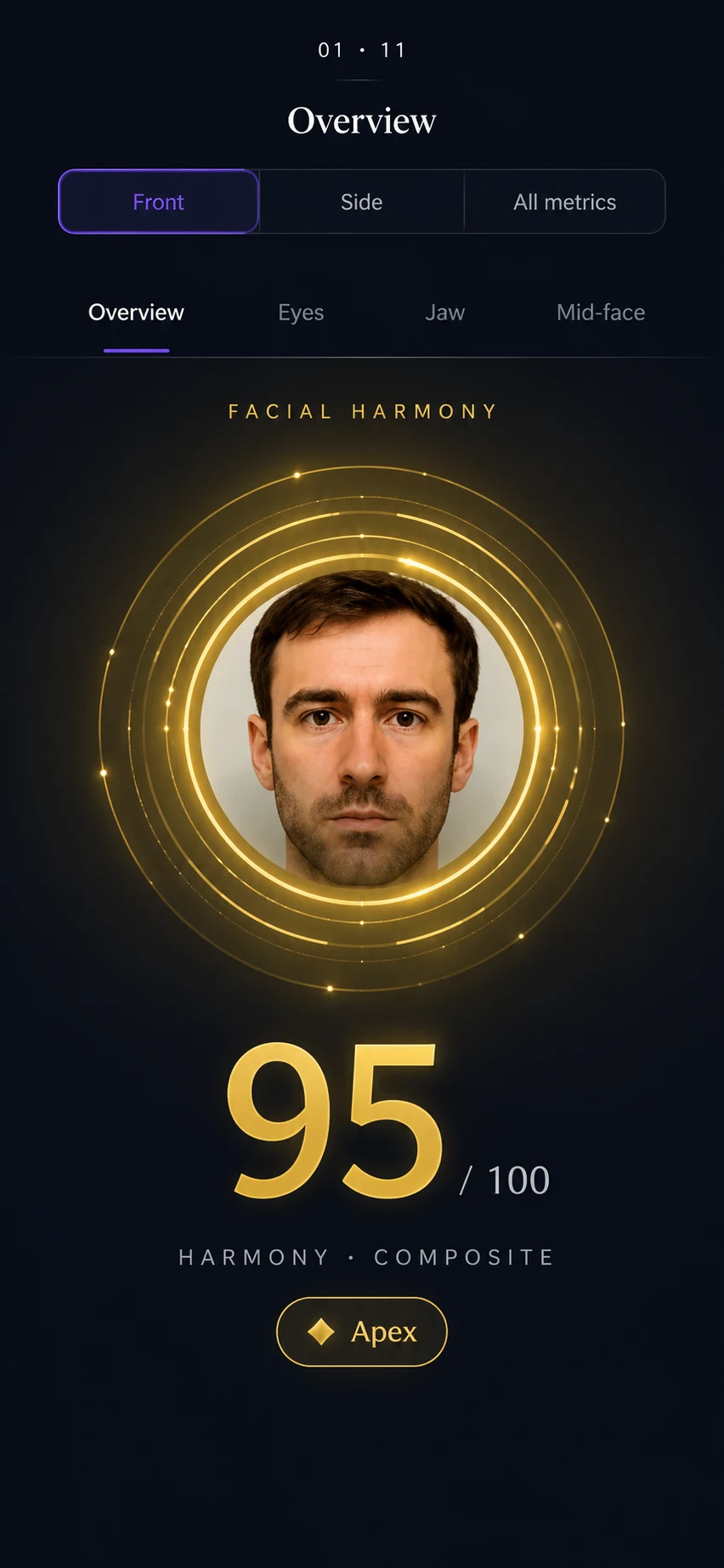
Two photos — a front shot and a side profile. 468 facial landmarks are placed, then 75 geometric measurements are computed and each is compared against its ideal range from published anthropometric literature. Those roll up into a harmony score from 0 to 100, and the score maps onto the tier table below.
It is deterministic. The same photo returns the same tier — which is the whole point, and the thing a vote-based rating can never offer.
Score map / quick read
One score. Nine community tiers.
The bar shows the threshold, not a judgement. The measurements underneath the tier are the part you can actually use.
Every PSL tier, and what it means
| Score | Tier | What it means |
|---|---|---|
| 98+ | True Adam | The ceiling of the scale — a composite of 98 or higher. |
| 94+ | Adamlite | Near-perfect measured proportions. |
| 88+ | Chad | Top of the ladder short of the Adam tiers. |
| 82+ | Chadlite | Significantly above-average presence. |
| 72+ | HTN | High Tier Normie — above-average. |
| 55+ | MTN | Mid Tier Normie — average. |
| 40+ | LTN | Low Tier Normie — below average. |
| 28+ | Sub5 | Notably below average. |
| 18+ | Sub3 | Substantially below average. |
GlowAI shows this tier next to a plain-language one — Apex, Elite, Above Average, Average, Below Average — so the result is readable whether or not you know the jargon.
The tier is the least useful part of the result
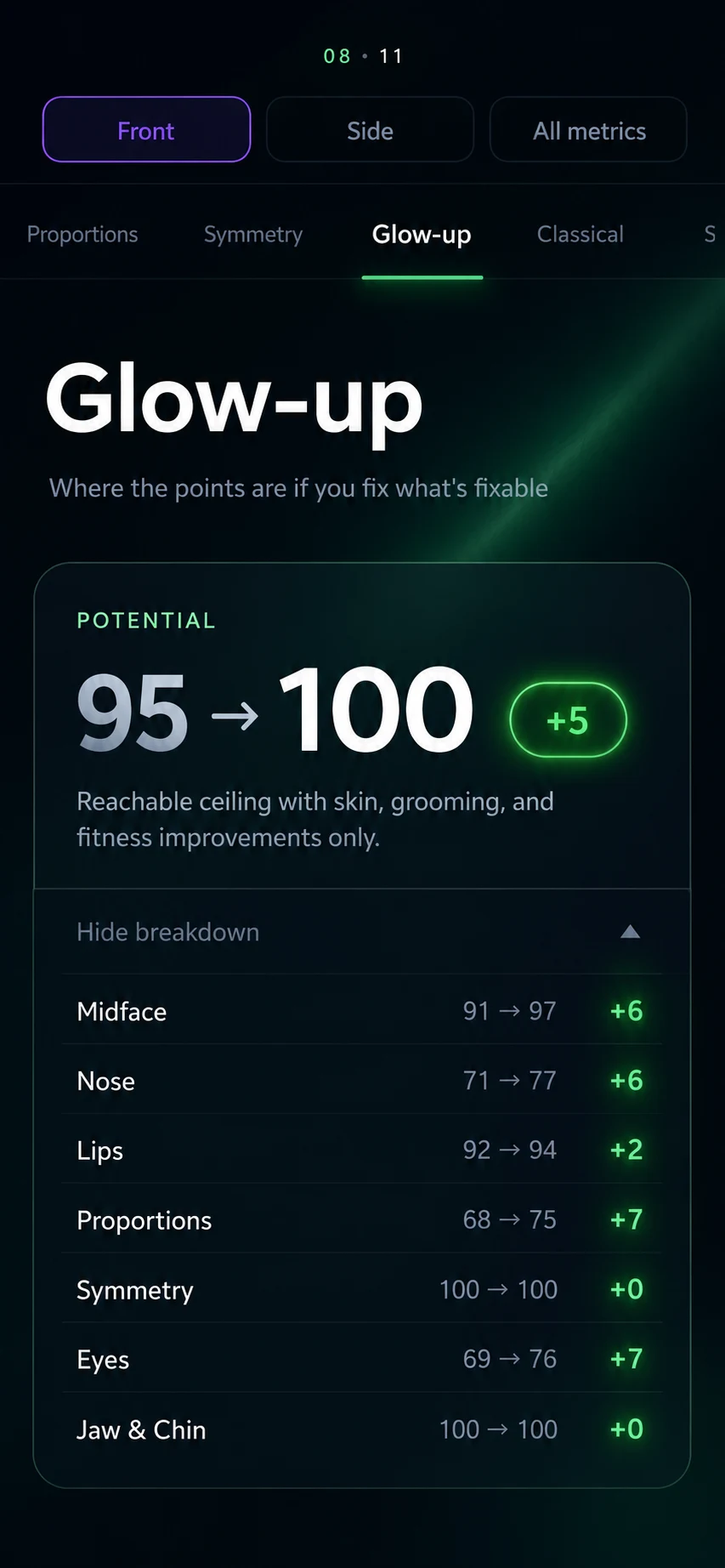
A tier is one number standing in for 75. It compresses away exactly the information you need: which measurements are weak, by how much, and whether any routine on earth can move them.
The useful screen is the ranked list underneath — your fixable measurements sorted by how much closing the gap would move your score. That is a plan. A tier is just a label.
A word on using this well
These tiers are community shorthand and some of the labels are blunt. A harmony score describes how your proportions compare to population ranges. It is not a measure of your worth, and it says nothing about how you come across to another person, where expression, grooming and confidence do work no ratio captures. If tracking the number starts to feel bad rather than useful, put it down; the app is built to hand you a short list and get out of the way.
Related: how the harmony score is built, how the scan works, and turning it into a routine.
Common questions
What does PSL stand for?
PSL comes from the three forums the rating scale grew out of. In practice it is shorthand for a shared vocabulary of tiers — Sub3, LTN, MTN, HTN, Chadlite, Chad and above — that people use to describe facial aesthetics more precisely than a 1-to-10 score.
How is a PSL rating calculated?
In most places it is not calculated at all — someone posts photos and strangers vote. GlowAI derives it instead: 75 geometric measurements are taken from two photos, each is scored against its published ideal range, they roll up into a harmony score from 0 to 100, and that score maps onto the tier table. Same photo, same tier.
What is a good PSL score?
MTN, around 55 to 72, is genuinely average — most people land there, and it is not an insult. HTN is above average. Chadlite and above are rare by definition. The tier is far less useful than the individual measurements underneath it, which are the part you can act on.
Can I raise my PSL rating?
Partly. Measurements driven by skin quality, body composition, grooming, hydration and sleep respond to consistent effort and will move your score. Measurements driven by skeletal structure will not change without surgery. GlowAI labels which is which so you are not spending months on something a routine cannot move.
Is the PSL scale accurate?
The scale itself is community convention, not science. What can be made rigorous is the measurement underneath it — GlowAI’s ranges come from published anthropometric literature and every metric carries its citation. Treat the tier as a label on a number, and the number as a description of proportions, not a verdict on you.
Sources
Ideal ranges are taken from published anthropometric literature. Every metric in the app carries its own citation; these are the works the set is built on.
- Farkas LG. Anthropometry of the Head and Face. 2nd ed. Raven Press, 1994. (opens in a new tab)
The reference dataset for human craniofacial measurement — the source of most normative ranges in use today.
- Powell N, Humphreys B. Proportions of the Aesthetic Face. Thieme-Stratton, 1984. (opens in a new tab)
Defines the profile angles — nasofrontal, nasofacial, nasomental, mentocervical — used in the side-profile analysis.
- Naini FB. Facial Aesthetics: Concepts and Clinical Diagnosis. Wiley-Blackwell, 2011. (opens in a new tab)
Modern synthesis of facial proportion assessment, and the source for several vertical-thirds and horizontal-fifths ranges.
- Sarver DM. Esthetic Orthodontics and Orthognathic Surgery. Mosby, 1998. (opens in a new tab)
Soft-tissue analysis — lip projection, smile arc and incisor display.
- Mommaerts MY, et al. Published work on facial proportion and orthognathic planning. (opens in a new tab)
Contemporary maxillofacial ranges, including midface and chin projection.
Next action
Get your harmony score. The first scan is free.
75 measurements, your PSL tier, and the three fixes that would move your score most.